
Baby-Led Weaning, Spoon-Feeding or a Mix?
Pros, research findings and the safety rules that never change
Lokmi Editorial Team · Last updated: · 4 min read · Relevant age: 6–12 months
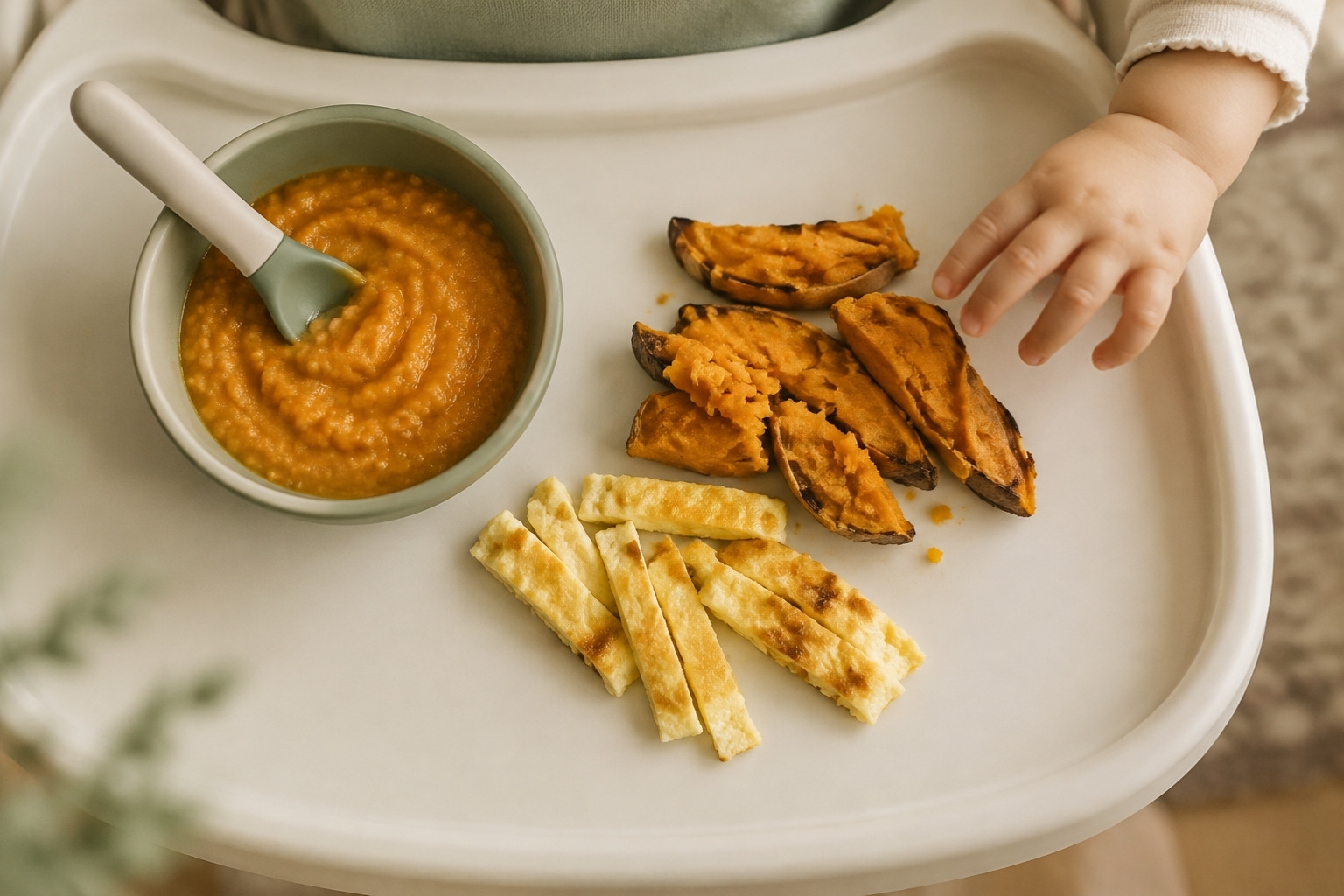
On social media you will see babies clutching fistfuls of broccoli on one side and bowls of purée on the other. The debate over weaning methods can start to feel like picking a team. The evidence, however, paints a more flexible picture that lets families choose what suits them. This article describes the three approaches, what research shows, and the safety rules that stay the same whichever you choose.
The three approaches in brief
Spoon-feeding (traditional): a parent offers purées or mashed foods by spoon, and textures gradually progress to lumpy, chopped and finger foods.
Baby-led weaning (BLW): from the start, the baby feeds themselves soft, appropriately sized foods they can hold; purées and spoon-feeding are absent or very limited.
Mixed (flexible) approach: spoon-fed mashed foods and finger foods the baby holds are used during the same period. This is what many families do in practice.
What does the research say?
Weight and growth: in the BLISS randomised controlled trial in New Zealand, a BLW approach modified to address choking concerns, with support for families, did not significantly change body mass index at 12 or 24 months compared with traditional feeding [1][2]. Strong claims that BLW prevents excess weight, or that it leads to underfeeding, were therefore not supported by this trial.
Choking: in an analysis by the same research group, babies of BLW families who had received safety education did not choke more often than those in the traditional group [2]. But there was another striking finding: in both groups, a large share of babies were offered foods with a high choking risk [2]. An observational study based on parent reports also found no difference in choking frequency between methods [3]. The lesson is that choking risk depends less on the method than on food shape, texture and supervision.
Iron: the most common concern about BLW is that a baby feeding themselves may not eat enough iron-rich food. Whatever method you choose, iron sources such as meat, egg and pulses should be on the plate every day [4].
Limits of the evidence: the number of studies is small, and most evaluated programmes that educated families about safety. The results may not apply directly to BLW practised without that guidance.
The common ground: responsive feeding
The World Health Organization (WHO) recommends that children aged 6–23 months be fed responsively — encouraged to feed themselves, with their hunger and fullness cues respected [5]. This principle works with both spoon-feeding and BLW. A parent who spoon-feeds can wait for the baby to open their mouth, stop when the baby turns away, and give the baby their own spoon or a piece of soft food.
Which approach might suit whom?
| Situation | What to consider |
|---|---|
| Baby is doing well with sitting and hand skills | BLW or a mixed approach may suit |
| Preterm birth, low muscle tone, swallowing difficulty | Plan the method with a doctor or feeding therapist |
| Risk of iron deficiency or slow weight gain | Plan with a doctor; a mixed approach where iron-rich foods are also spoon-fed may be an option |
| A carer or nursery feeds the baby | All caregivers need to know the same safety rules |
BLW is not advised before six months, because finger feeding requires well-developed sitting and hand skills [6].
Rules that stay the same whatever the method
- Upright seating: your baby should sit upright in a high chair, never lying back or in a car seat [7].
- Constant supervision: an adult should always be beside the baby while they eat, not distracted by a phone or other tasks [7].
- Safe shapes: finger foods should be soft enough to squash easily between thumb and forefinger. Whole grapes, whole cherry tomatoes, raw carrot and apple, whole nuts and sausages are choking hazards [7].
- Don't put food into your baby's mouth for them in BLW: the baby brings food to their own mouth; stuffing the mouth or feeding while the baby is crying is dangerous.
- No honey, no added salt or sugar [8].
Sample mixed meal (8 months)
- By spoon: mashed red lentil soup (no salt, with tomato)
- By hand: finger-length courgette sticks steamed until soft
- By hand: strips of well-cooked omelette
- In an open cup: a few sips of water
When to see a doctor
- your baby feeds themselves but is not gaining weight or is dropping across growth-chart lines;
- they gag or vomit persistently at every meal or become fearful of eating;
- they still cannot manage textured foods at 9–10 months;
- they cough often or their breathing changes during meals.
Emergency
Inability to make sound, ineffective coughing and turning blue are signs of choking. Shout for help and call your local emergency number. A baby first-aid course before starting solids is strongly recommended.
Key takeaways
- BLW, spoon-feeding and mixed approaches can all be done safely; there is no single right method.
- Research suggests BLW with safety education does not increase choking, but risky foods are frequently offered with both methods.
- Plan iron-rich foods every day.
- Whatever the method: upright seating, constant supervision and safe food shapes.
Please note
This article is general information; it does not replace medical advice, diagnosis or treatment for your child. Its statements were checked against the organisations and publications linked below (such as WHO, NHS, CDC, AAP and the Turkish Ministry of Health). Talk to your family doctor or paediatrician about decisions for your child; in an emergency, call your local emergency number.
Last updated: 8 November 2026 · Sources checked: 9 November 2026 · The cover image was generated with AI.
Sources
- [1] Taylor RW et al.. Effect of a Baby-Led Approach to Complementary Feeding on Infant Growth and Overweight: A Randomized Clinical Trial. JAMA Pediatr 2017;171:838-846 · Accessed: 8 November 2026
- [2] Fangupo LJ et al.. A Baby-Led Approach to Eating Solids and Risk of Choking. Pediatrics 2016;138(4):e20160772 · Accessed: 8 November 2026
- [3] Brown A. No difference in self-reported frequency of choking between infants introduced to solid foods using a baby-led weaning or traditional spoon-feeding approach. J Hum Nutr Diet 2018;31:496-504 · Accessed: 8 November 2026
- [4] US Centers for Disease Control and Prevention. Iron · Accessed: 8 November 2026
- [5] World Health Organization. WHO Guideline for complementary feeding of infants and young children 6–23 months of age · Accessed: 8 November 2026
- [6] American Academy of Pediatrics (HealthyChildren.org). When Can Babies Start Solid Foods? Readiness & Feeding Tips · Accessed: 8 November 2026
- [7] US Centers for Disease Control and Prevention. Choking Hazards · Accessed: 8 November 2026
- [8] US Centers for Disease Control and Prevention. Foods and Drinks to Avoid or Limit · Accessed: 8 November 2026
More free articles
Starting solids and safety
Starting Solid Foods: The Essentials
When, how and what to watch for as your baby begins solids
5 min read · Free
Starting solids and safety
Why Start Solids at Around Six Months?
The science behind the six-month recommendation and how health bodies differ
5 min read · Free
Starting solids and safety
Is My Baby Ready for Solids? The Real Readiness Signs
Genuine signs, misleading cues and how to observe your baby
5 min read · Free