
Starting Solid Foods: The Essentials
When, how and what to watch for as your baby begins solids
Lokmi Editorial Team · Last updated: · 5 min read · Relevant age: 4–24 months
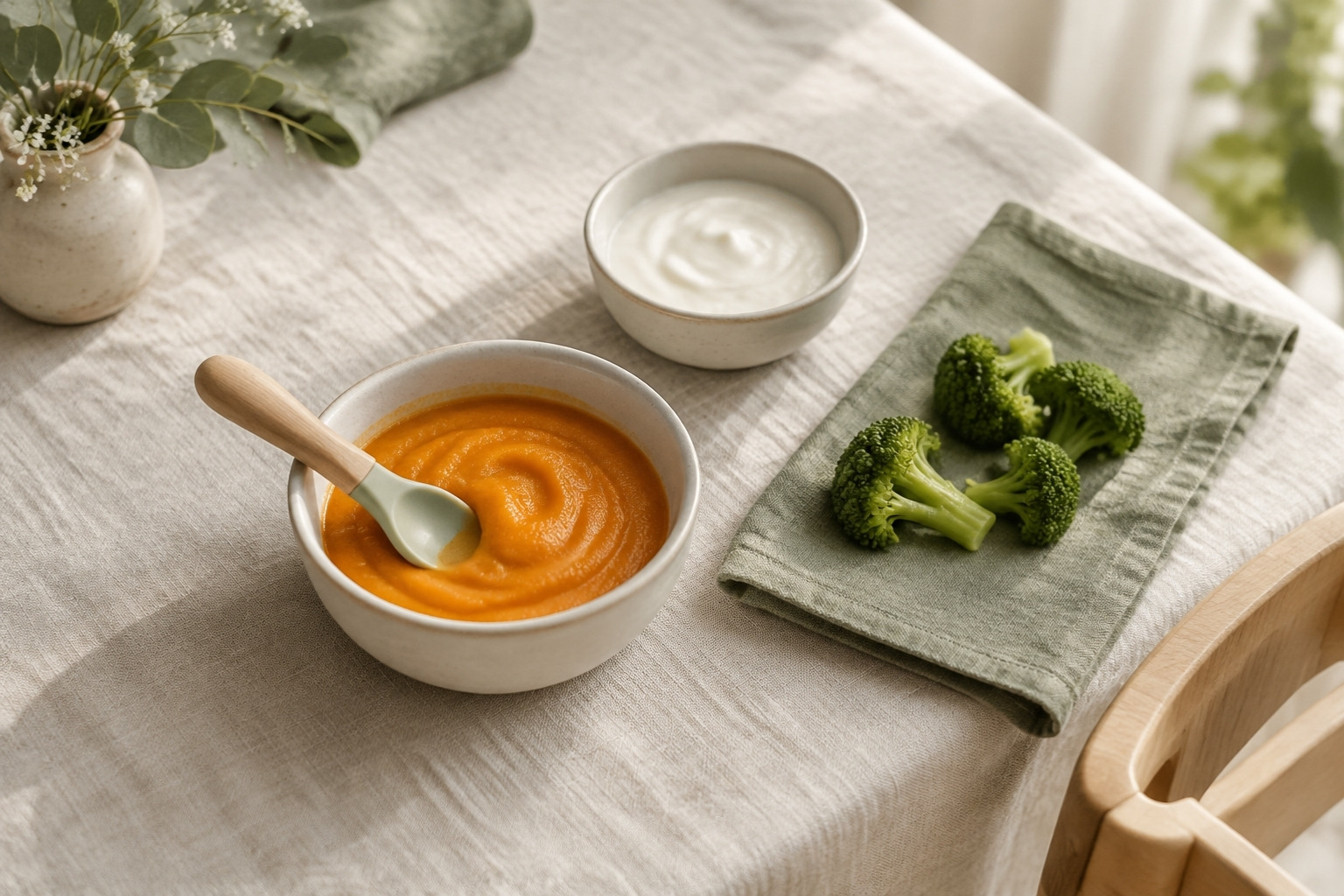
Complementary feeding is the stretch from about six months to two years when your baby learns to eat foods beyond milk. This guide covers when to begin, the first weeks, safety rules for every meal and when to involve your doctor.
In short: when and why do solids begin?
The World Health Organization (WHO) and Türkiye's Ministry of Health recommend breast milk alone for the first six months, followed by complementary foods alongside continued breastfeeding [1][2][6][17]. WHO's 2023 guideline recommends introducing complementary foods at six months (around 180 days) and continuing breastfeeding to two years or beyond [1]. Formula-fed babies follow the same approach: solids start around six months, once the baby is ready [3].
Why then? After six months, milk alone no longer covers a baby's needs for energy and certain nutrients such as iron and zinc [2]. Around the same time, most babies develop the sitting, hand-to-mouth and swallowing skills that eating requires.
Readiness matters as much as the calendar
Six months is a guide; your baby's development is what really decides. Signs of readiness include [3][15]:
- sitting upright, alone or with support, with good head control;
- opening the mouth when a spoon approaches;
- moving food to the back of the mouth and swallowing instead of pushing it out with the tongue;
- grasping objects and bringing them to the mouth.
Night waking, fist sucking or wanting extra milk feeds are not, on their own, signs of readiness [15]. Starting solids before four months is not recommended [3]. If your baby was born preterm or has developmental differences, plan the timing with your doctor.
The first weeks: getting acquainted, not filling up
A few teaspoons are enough at first. The US Centers for Disease Control and Prevention (CDC) suggests starting with 1–2 tablespoons and following your baby's hunger and fullness cues [8]. Breast milk or formula remains the main source of nutrition; solids do not abruptly replace it.
WHO recommends increasing meal frequency with age: 2–3 meals a day at 6–8 months, and 3–4 meals a day at 9–23 months, with 1–2 snacks if needed [2]. Texture should progress too, from smooth or mashed first foods towards lumpier, chopped and finger foods.
What belongs on the plate?
Variety is a key message of WHO's 2023 guideline: animal-source foods such as meat, fish or eggs every day; vegetables and fruit every day; and pulses such as lentils and chickpeas, plus nuts and seeds in a safe form, frequently [1].
Traditional Turkish home cooking offers plenty of good starting points: plain unstrained yoghurt, mashed courgette and carrot, well-cooked mashed red lentils, soft fine bulgur, thoroughly cooked egg and flaked, boneless fish.
Don't forget iron. Iron needs rise markedly from six months [18]. Red meat, poultry, eggs, pulses and dark leafy greens should appear regularly from the first weeks [7]. In Türkiye, national programmes also recommend vitamin D for infants and preventive iron during a defined period [16][17]; your family doctor will advise on when and how to use these.
Allergenic foods: no need to delay
There is no need to wait until the first birthday for foods more likely to cause allergy, such as egg, peanut, dairy, wheat, fish and sesame. The UK National Health Service (NHS) advises that these can be offered from around six months, one at a time and in very small amounts, and that foods your baby tolerates should then stay in the diet regularly [4]. Peanuts and tree nuts must never be given whole; offer them finely ground or as a smooth paste mixed into food.
If your baby has eczema or a diagnosed food allergy, has reacted to a food before, or there is a family history of food allergy, eczema, asthma or hay fever, talk to your doctor before introducing allergenic foods [4].
Safety rules for every meal
- Upright and supervised: your baby should sit upright in a high chair, always with an adult present. Avoid feeding in a pushchair, bouncer or car seat [5].
- Shape and texture: whole grapes, whole cherry tomatoes, raw carrot or apple pieces, whole nuts, popcorn and hard sweets are choking hazards at this age [5]. Quarter round foods lengthways and cook hard vegetables until soft.
- No honey: babies under 12 months should not have honey, even in cooked foods, because it can cause infant botulism [9][10].
- No added salt or sugar: there is no need to add salt, sugar, grape molasses (pekmez) or syrups to baby food [1][14][6].
- Cow's milk as a drink after 12 months: small amounts can be used in cooking, but it should not be given as a drink before the first birthday [10][6].
Gagging is normal; choking is an emergency
Gagging is very common in the first weeks and is a normal reflex that shows your baby is adapting to new textures. A gagging baby is usually noisy, may go red in the face and pushes food forward with the tongue. Severe choking is usually quiet: the baby cannot make sound or cough effectively, and the lips or nail beds may turn blue [11]. With a partial blockage a baby may cough loudly; let them keep coughing and stay with them [13]. If the cough is silent or ineffective, shout for help and call your local emergency number. If your child is conscious, start age-appropriate first aid: back blows and chest thrusts under 1 year, back blows and abdominal thrusts over 1 year [13]. A baby first-aid course before starting solids is very worthwhile.
Common mistakes
- distracting a baby with screens or games to slip food in;
- pressuring or rewarding a child to finish the plate;
- giving up on a food after the first refusal (it may take 8–10 exposures before a young child is willing to try a new food) [12];
- sticking to fruit purées and delaying iron-rich foods;
- assuming all ready-made baby products are equally good.
When to see a doctor
- your baby persistently refuses food, is not gaining weight or is dropping across growth-chart lines;
- you notice real difficulty swallowing, frequent coughing during meals or breathing difficulty;
- hives, vomiting or lip swelling follow a new food;
- you are unsure about timing because of prematurity, a chronic condition or developmental delay.
Emergency warning signs
Difficulty breathing, wheezing, swelling of the tongue or throat, a hoarse voice, widespread hives with floppiness, or reduced alertness may signal a severe allergic reaction (anaphylaxis) [19]. Silent, ineffective coughing with blue discolouration suggests a blocked airway. In either case, call your emergency number immediately.
Key takeaways
- Solids start around six months, when your baby shows readiness signs; breastfeeding continues.
- In the first weeks the goal is familiarity; your baby's cues decide the amount.
- Iron-rich foods and variety matter from the very start.
- Allergenic foods are not delayed until age one; if there are risk factors, plan with your doctor.
- Honey, added salt and sugar, and choking-hazard shapes stay off the menu in the first year.
Please note
This article is general information; it does not replace medical advice, diagnosis or treatment for your child. Its statements were checked against the organisations and publications linked below (such as WHO, NHS, CDC, AAP and the Turkish Ministry of Health). Talk to your family doctor or paediatrician about decisions for your child; in an emergency, call your local emergency number.
Last updated: 8 November 2026 · Sources checked: 9 November 2026 · The cover image was generated with AI.
Sources
- [1] World Health Organization. WHO Guideline for complementary feeding of infants and young children 6–23 months of age · Accessed: 8 November 2026
- [2] World Health Organization. Infant and young child feeding (fact sheet) · Accessed: 8 November 2026
- [3] US Centers for Disease Control and Prevention. When, What, and How to Introduce Solid Foods · Accessed: 8 November 2026
- [4] NHS (Best Start in Life). Introducing foods that could trigger an allergic reaction · Accessed: 8 November 2026
- [5] US Centers for Disease Control and Prevention. Choking Hazards · Accessed: 8 November 2026
- [6] SBÜ İzmir Dr. Behçet Uz Çocuk Hastalıkları ve Cerrahisi EAH (T.C. Sağlık Bakanlığı). Tamamlayıcı Beslenme · Accessed: 8 November 2026
- [7] US Centers for Disease Control and Prevention. Iron · Accessed: 8 November 2026
- [8] US Centers for Disease Control and Prevention. How Much and How Often To Feed · Accessed: 8 November 2026
- [9] US Centers for Disease Control and Prevention. Foods and Drinks to Avoid or Limit · Accessed: 8 November 2026
- [10] NHS (Best Start in Life). Foods and drinks to avoid (Safe weaning) · Accessed: 8 November 2026
- [11] NHS (Best Start in Life). Choking and gagging on food · Accessed: 8 November 2026
- [12] US Centers for Disease Control and Prevention. Picky Eaters and What to Do · Accessed: 8 November 2026
- [13] NHS. How to stop a child from choking · Accessed: 8 November 2026
- [14] World Health Organization. Healthy diet (fact sheet) · Accessed: 9 November 2026
- [15] NHS. Your baby's first solid foods · Accessed: 9 November 2026
- [16] T.C. Sağlık Bakanlığı Bilim Kurulu / Halk Sağlığı Genel Müdürlüğü. Bebek ve Çocuklarda D Vitamini Ölçümü, Profilaksisi, D Vitamini Eksikliğinin Tanımlanması ve Tedavisi, D Vitamini İntoksikasyonu Konularında Sağlık Bakanlığı Bilim Kurulu Rehberi · Accessed: 9 November 2026
- [17] T.C. Sağlık Bakanlığı Halk Sağlığı Genel Müdürlüğü. Demir Gibi Türkiye Programı Uygulama Rehberi · Accessed: 9 November 2026
- [18] NIH Office of Dietary Supplements. Iron – Fact Sheet for Health Professionals · Accessed: 9 November 2026
- [19] NHS. Anaphylaxis · Accessed: 9 November 2026
More free articles
Starting solids and safety
Why Start Solids at Around Six Months?
The science behind the six-month recommendation and how health bodies differ
5 min read · Free
Starting solids and safety
Is My Baby Ready for Solids? The Real Readiness Signs
Genuine signs, misleading cues and how to observe your baby
5 min read · Free
Starting solids and safety
The First Week of Solids: Where and How to Begin
First spoonfuls, first foods and the rhythm of adding new flavours
5 min read · Free