
Is My Baby Ready for Solids? The Real Readiness Signs
Genuine signs, misleading cues and how to observe your baby
Lokmi Editorial Team · Last updated: · 5 min read · Relevant age: 4–8 months
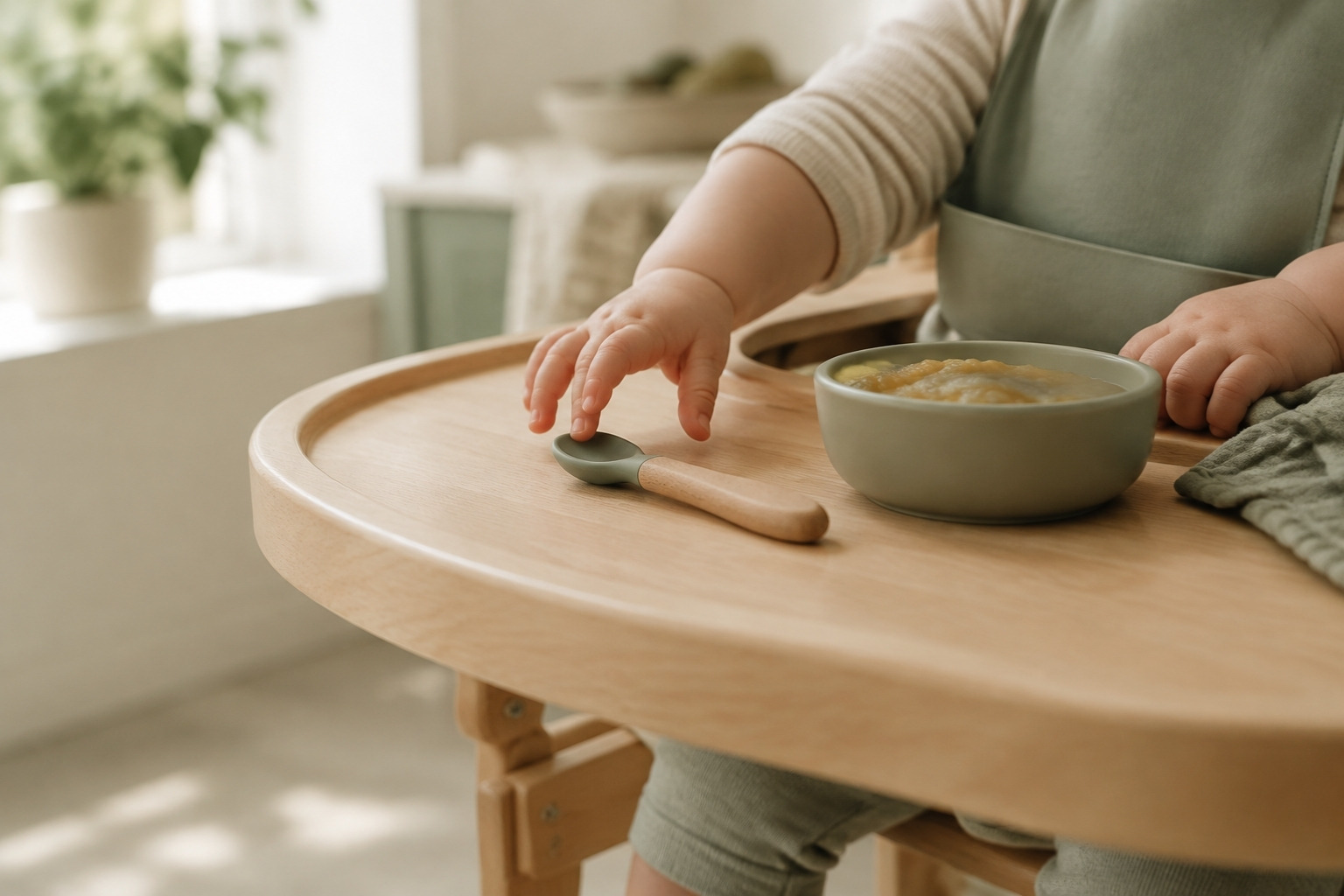
It is lovely when your baby follows your fork with their eyes or stuffs a fist in their mouth, but on their own these do not mean "I'm ready for solids". Readiness is a cluster of skills that show the body and nervous system are prepared to eat. This article describes the genuine signs, the commonly misread ones, and what to look for as you observe your baby.
The short answer
Most babies develop these skills around six months. The US Centers for Disease Control and Prevention (CDC) and the American Academy of Pediatrics (AAP) treat the signs below, seen together, as indicators of readiness [1][2]. Starting solids before four months is not recommended [1].
Genuine readiness signs
| Sign | Why it matters |
|---|---|
| Sitting up, alone or with support, with a steady head | Safe swallowing needs trunk and head control [1] |
| Opening the mouth as food approaches | Shows interest and willingness [1] |
| Moving food back and swallowing instead of pushing it out with the tongue | Shows the tongue-thrust reflex is fading [1] |
| Grasping objects and bringing them to the mouth | Hand–eye–mouth coordination has developed [1] |
| Trying to pick up small objects | Prepares for finger feeding [1] |
One sign alone is not enough. A four-month-old who brings toys to the mouth but cannot yet sit even with support is not ready.
Signs that are often misread
These are very common in babies but do not, on their own, show readiness:
- Waking more at night: sleep patterns naturally shift at 4–6 months. Starting early in the hope of better sleep is not a sound reason [9].
- Sucking fists or toys: this is how babies explore the world, and it increases with teething.
- Watching you eat: a sign of curiosity and social interest, not of swallowing skill.
- Feeding more often or wanting more formula: this can happen during growth spurts. Milk feeds can usually be increased first [9].
How to observe your baby
Watching over several days gives a more reliable picture than a single attempt:
- Sitting: when supported in a high chair or on your lap, can your baby hold their head steady without wobbling?
- Opening the mouth: when you bring an empty baby spoon to their lips, do they open up or turn away?
- Swallowing: if most of a few spoonfuls of purée come straight back out, the tongue-thrust reflex may still be strong. Pausing for a week or two and trying again is reasonable.
- Hand skills: can they hold a toy and bring it to their mouth?
If your baby isn't ready at six months
Babies develop at different speeds, and some become ready a few days or weeks after six months. Meanwhile, breast milk or formula remains the main source of nutrition. But waiting has limits: the European Society for Paediatric Gastroenterology, Hepatology and Nutrition (ESPGHAN) advises not delaying complementary feeding beyond 26 weeks [3]. Iron needs also rise after six months [4].
In babies born preterm, the timing of starting solids should always be planned with the doctor [5][9].
Taking the first step when your baby is ready
- Choose a calm moment when your baby is neither tired nor very hungry; trying shortly after a milk feed can help.
- Seat them upright in a high chair; feet resting on a support improves stability.
- Start with a few teaspoons of smooth or well-mashed food; the CDC suggests beginning with 1–2 tablespoons and following your baby's cues [6].
- If your baby turns away, closes their mouth or cries, don't force it; the AAP suggests going back to milk feeds alone for a while before trying again [2].
What should go on the first plate?
Readiness opens not only the question of "when" but also "what to start with". The AAP says first foods do not need to be given in any particular order [1][2]. Iron, however, deserves special attention: according to general US reference values published by the National Institutes of Health (NIH), a baby's daily iron requirement rises from about 0.27 mg in the first 6 months to 11 mg at 7–12 months, and even babies born at term can develop iron deficiency at 6–9 months [4]. The European expert society ESPGHAN also recommends iron-rich complementary foods for all infants [3]. So from the first weeks it makes sense to include iron-containing foods such as well-cooked minced meat, fully cooked egg or well-mashed lentils.
Safety note
Even a baby showing every readiness sign must eat sitting upright and supervised. Hard, round foods such as whole grapes, whole nuts and raw carrot are choking hazards [7]. Honey is not given before 12 months [8].
When to see a doctor
- your baby is past six months and cannot hold their head steady or sit even with support;
- every attempt brings intense gagging, vomiting or coughing;
- you notice noisy breathing, a change in voice or blue colouring during feeds;
- you are worried about weight gain or growth;
- your baby was born preterm or has a diagnosis affecting neurological or muscular development.
Emergency
If during a meal your baby cannot make a sound, cannot cough effectively or is turning blue, they are choking: shout for help and call your local emergency number immediately.
Key takeaways
- Readiness means sitting upright, head control, opening the mouth, swallowing and bringing objects to the mouth — together.
- Night waking, fist sucking or watching you eat are not readiness signs on their own.
- Most babies reach these skills around six months; don't start before four months.
- If your baby isn't ready, don't rush — but don't delay beyond 26 weeks, and talk to your doctor.
Please note
This article is general information; it does not replace medical advice, diagnosis or treatment for your child. Its statements were checked against the organisations and publications linked below (such as WHO, NHS, CDC, AAP and the Turkish Ministry of Health). Talk to your family doctor or paediatrician about decisions for your child; in an emergency, call your local emergency number.
Last updated: 8 November 2026 · Sources checked: 9 November 2026 · The cover image was generated with AI.
Sources
- [1] US Centers for Disease Control and Prevention. When, What, and How to Introduce Solid Foods · Accessed: 8 November 2026
- [2] American Academy of Pediatrics (HealthyChildren.org). When Can Babies Start Solid Foods? Readiness & Feeding Tips · Accessed: 8 November 2026
- [3] ESPGHAN Committee on Nutrition (Fewtrell M et al.). Complementary Feeding: A Position Paper by ESPGHAN. J Pediatr Gastroenterol Nutr 2017;64(1):119-132 · Accessed: 8 November 2026
- [4] NIH Office of Dietary Supplements. Iron – Fact Sheet for Health Professionals · Accessed: 8 November 2026
- [5] Italian neonatal, paediatric and paediatric gastroenterology joint societies (Baldassarre ME et al.). Complementary feeding in preterm infants: a position paper by Italian neonatal, paediatric and paediatric gastroenterology joint societies. Ital J Pediatr 2022;48:143 · Accessed: 8 November 2026
- [6] US Centers for Disease Control and Prevention. How Much and How Often To Feed · Accessed: 8 November 2026
- [7] US Centers for Disease Control and Prevention. Choking Hazards · Accessed: 8 November 2026
- [8] US Centers for Disease Control and Prevention. Foods and Drinks to Avoid or Limit · Accessed: 8 November 2026
- [9] NHS. Your baby's first solid foods · Accessed: 9 November 2026
More free articles
Starting solids and safety
Starting Solid Foods: The Essentials
When, how and what to watch for as your baby begins solids
5 min read · Free
Starting solids and safety
Why Start Solids at Around Six Months?
The science behind the six-month recommendation and how health bodies differ
5 min read · Free
Starting solids and safety
The First Week of Solids: Where and How to Begin
First spoonfuls, first foods and the rhythm of adding new flavours
5 min read · Free