
Why Start Solids at Around Six Months?
The science behind the six-month recommendation and how health bodies differ
Lokmi Editorial Team · Last updated: · 5 min read · Relevant age: 4–8 months
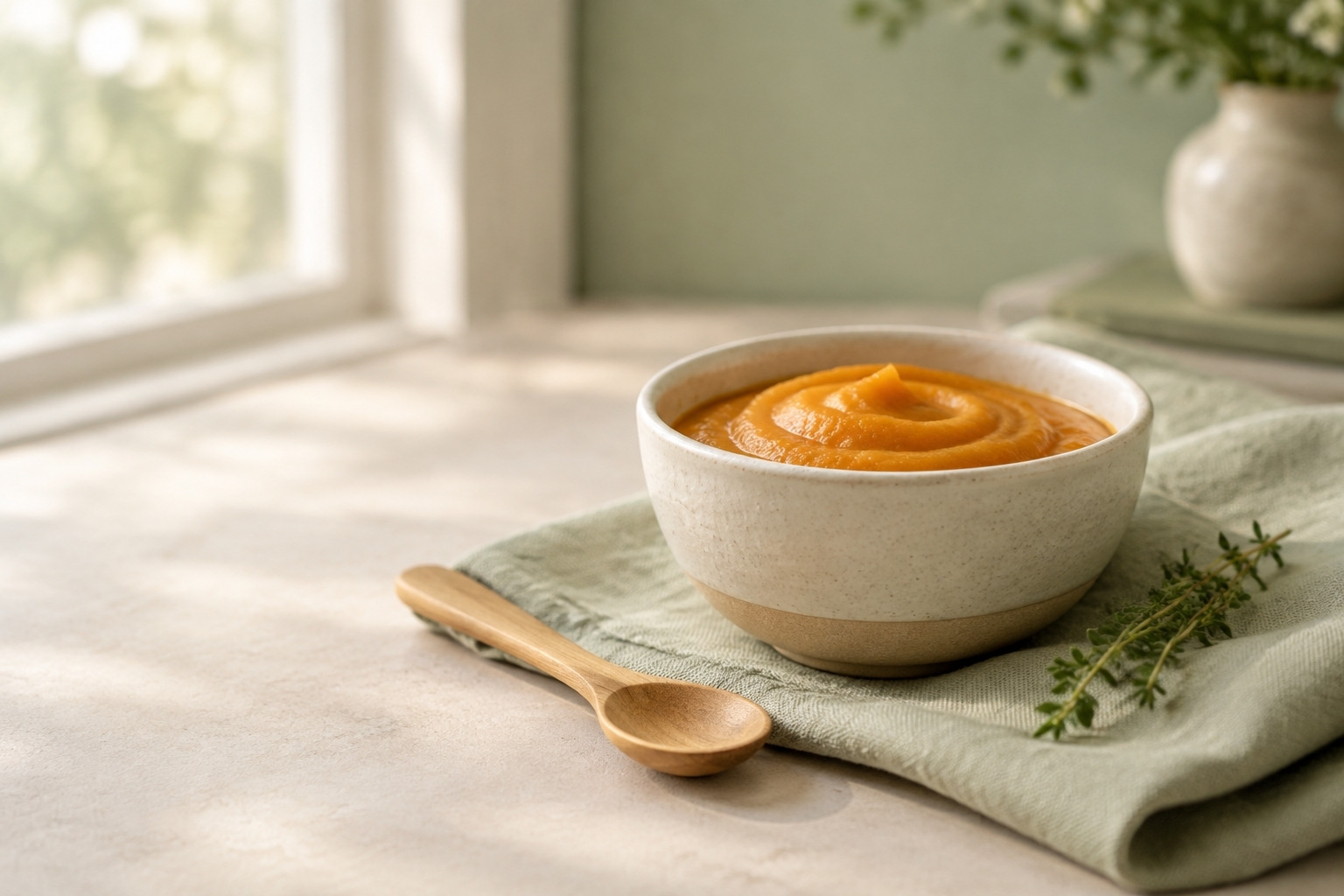
"My neighbour's baby was eating rice pudding at four months." "Ours is so hungry — shouldn't we start now?" Almost every family faces these questions. The six-month recommendation is not an arbitrary number: it reflects a baby's changing nutrient needs, maturing digestive and swallowing skills, and the protective value of breast milk. This article explains the reasoning, the subtle differences between health bodies, and how to decide for your own baby.
The short answer
The World Health Organization (WHO) recommends exclusive breastfeeding for the first six months and introducing complementary foods at six months (around day 180) while breastfeeding continues [1][2]. Türkiye's Ministry of Health takes the same position: breast milk alone for six months, then complementary feeding alongside breast milk [3]. The American Academy of Pediatrics (AAP) and the US Centers for Disease Control and Prevention (CDC) use the phrase "about six months" and stress that solids should not start before four months [4][5].
What changes at six months?
Nutrient needs rise. According to WHO, from about six months a baby's energy and nutrient requirements begin to exceed what breast milk alone provides [2]. Iron and zinc stand out. The US National Institutes of Health Office of Dietary Supplements (NIH ODS) notes that term infants can become iron deficient between six and nine months unless they receive iron-rich foods or iron-fortified formula [6]. Zinc in breast milk also falls markedly after the early months, so infants aged 7–12 months need zinc-containing foods [7].
Skills mature. By now most babies can sit with support, hold their head steady and bring objects to their mouth, and the reflex that pushes food out with the tongue fades. These skills are needed to eat safely from a spoon or by hand [5].
A learning window opens. WHO describes 6–23 months as a critical period in which children learn to accept healthy foods and long-term eating patterns take shape [1].
Possible downsides of starting early
Starting solids before four months is not recommended [5]. Solids introduced very early can displace breast milk or formula, so the baby drinks less milk. Where hygiene is poor, early complementary feeding can also increase the risk of infections such as diarrhoea. That is why WHO frames six months as a public-health recommendation [1].
At the same time, the WHO guideline notes that some infants may benefit from earlier introduction, and notes that mothers worried about milk supply may benefit from breastfeeding support [1]. The message is not that every baby who starts at four months is harmed; it is that starting early is not routinely needed and should not replace milk.
Possible downsides of waiting too long
Waiting until seven or eight months carries its own risks. Iron and zinc gaps can widen and growth can slow [2][6][7]. The European Society for Paediatric Gastroenterology, Hepatology and Nutrition (ESPGHAN) advises that complementary feeding should not be delayed beyond 26 weeks [8]. The NHS also advises moving on from purées to mashed and finger foods as soon as your baby is ready [10]; in an observational study, children first given lumpy foods after 9 months had more feeding difficulties at age 7 [11].
Why do health bodies phrase it differently?
| Organisation | Wording |
|---|---|
| WHO (2023) | Start at 6 months (180 days) while continuing to breastfeed [1] |
| Türkiye Ministry of Health | Breast milk alone for 6 months, then complementary feeding [3] |
| AAP / CDC | Around 6 months; not before 4 months [4][5] |
| ESPGHAN (2017) | Not before 17 weeks; not delayed beyond 26 weeks [8] |
| European Food Safety Authority (EFSA, 2019) | Most infants need complementary foods from around 6 months; some infants at risk of iron depletion may benefit from earlier, iron-containing foods [9] |
These differences reflect perspective rather than contradiction. WHO sets one clear target for the whole world, including communities where hygiene and food access vary enormously. ESPGHAN and EFSA define an acceptable window for European infants in settings where properly prepared foods can be given safely. In Türkiye, the official recommendation is six months, and family doctors follow babies against it.
Lokmi's approach: for a healthy baby born at term, the goal is six months. If your baby shows readiness signs unusually early or late, or there are questions about weight gain, decide together with your paediatrician.
How to decide for your baby
- Look for readiness signs: sitting with support, head control, opening the mouth for the spoon, swallowing food, and bringing objects to the mouth [5].
- Don't decide on appetite alone: frequent feeding or night waking at 4–6 months are normal baby behaviours and, on their own, not a reason to start solids [12].
- For babies born preterm, plan the timing with your doctor [12].
- Keep milk feeds going: starting solids does not mean stopping breastfeeding or formula [1].
Common myths
- "If fruit comes first, my baby will never like vegetables." The AAP notes there is no evidence that offering fruit first causes a dislike of vegetables; what matters is offering vegetables regularly and repeatedly [4].
- "Adding cereal or rice flour to the bottle is a good early start." Adding cereal to bottles is not recommended because it can cause choking and overfeeding [4]. In special situations such as reflux, thickening is used only on a doctor's advice.
- "Six months means filling meals from day one." A few spoonfuls are enough at first; milk remains the main source of nutrition [4].
When to talk to your doctor
- your baby is nearing six months and still cannot hold their head steady or sit with support;
- weight gain between four and six months is poor, or your baby is dropping across growth-chart lines;
- you are unsure about timing because of prematurity, low birth weight, reflux or a chronic condition;
- after seven months your baby shows no interest in solids at all, or gags and vomits intensely with every attempt.
Key takeaways
- WHO and Türkiye's Ministry of Health recommend breast milk alone for six months, then complementary foods alongside breastfeeding.
- Don't start before four months, and don't delay beyond 26 weeks.
- Development matters as much as the calendar; readiness signs decide.
- Iron and zinc needs rise after six months, so these nutrients matter from the first weeks.
- In special circumstances, timing is decided individually with your doctor.
Please note
This article is general information; it does not replace medical advice, diagnosis or treatment for your child. Its statements were checked against the organisations and publications linked below (such as WHO, NHS, CDC, AAP and the Turkish Ministry of Health). Talk to your family doctor or paediatrician about decisions for your child; in an emergency, call your local emergency number.
Last updated: 8 November 2026 · Sources checked: 9 November 2026 · The cover image was generated with AI.
Sources
- [1] World Health Organization. WHO Guideline for complementary feeding of infants and young children 6–23 months of age · Accessed: 8 November 2026
- [2] World Health Organization. Infant and young child feeding (fact sheet) · Accessed: 8 November 2026
- [3] T.C. Sağlık Bakanlığı Halk Sağlığı Genel Müdürlüğü. Türkiye Beslenme Rehberi (TÜBER) 2022 · Accessed: 8 November 2026
- [4] American Academy of Pediatrics (HealthyChildren.org). When Can Babies Start Solid Foods? Readiness & Feeding Tips · Accessed: 8 November 2026
- [5] US Centers for Disease Control and Prevention. When, What, and How to Introduce Solid Foods · Accessed: 8 November 2026
- [6] NIH Office of Dietary Supplements. Iron – Fact Sheet for Health Professionals · Accessed: 8 November 2026
- [7] NIH Office of Dietary Supplements. Zinc – Fact Sheet for Health Professionals · Accessed: 8 November 2026
- [8] ESPGHAN Committee on Nutrition (Fewtrell M et al.). Complementary Feeding: A Position Paper by ESPGHAN. J Pediatr Gastroenterol Nutr 2017;64(1):119-132 · Accessed: 8 November 2026
- [9] EFSA NDA Panel. Appropriate age range for introduction of complementary feeding into an infant's diet. EFSA Journal 2019;17(9):5780 · Accessed: 8 November 2026
- [10] NHS (Best Start in Life). 6 months – Feeding your baby · Accessed: 9 November 2026
- [11] Coulthard H, Harris G, Emmett P. Delayed introduction of lumpy foods to children during the complementary feeding period affects child's food acceptance and feeding at 7 years of age. Matern Child Nutr 2009;5(1):75-85 · Accessed: 9 November 2026
- [12] NHS. Your baby's first solid foods · Accessed: 9 November 2026
More free articles
Starting solids and safety
Starting Solid Foods: The Essentials
When, how and what to watch for as your baby begins solids
5 min read · Free
Starting solids and safety
Is My Baby Ready for Solids? The Real Readiness Signs
Genuine signs, misleading cues and how to observe your baby
5 min read · Free
Starting solids and safety
The First Week of Solids: Where and How to Begin
First spoonfuls, first foods and the rhythm of adding new flavours
5 min read · Free