
The First Week of Solids: Where and How to Begin
First spoonfuls, first foods and the rhythm of adding new flavours
Lokmi Editorial Team · Last updated: · 5 min read · Relevant age: 6–7 months
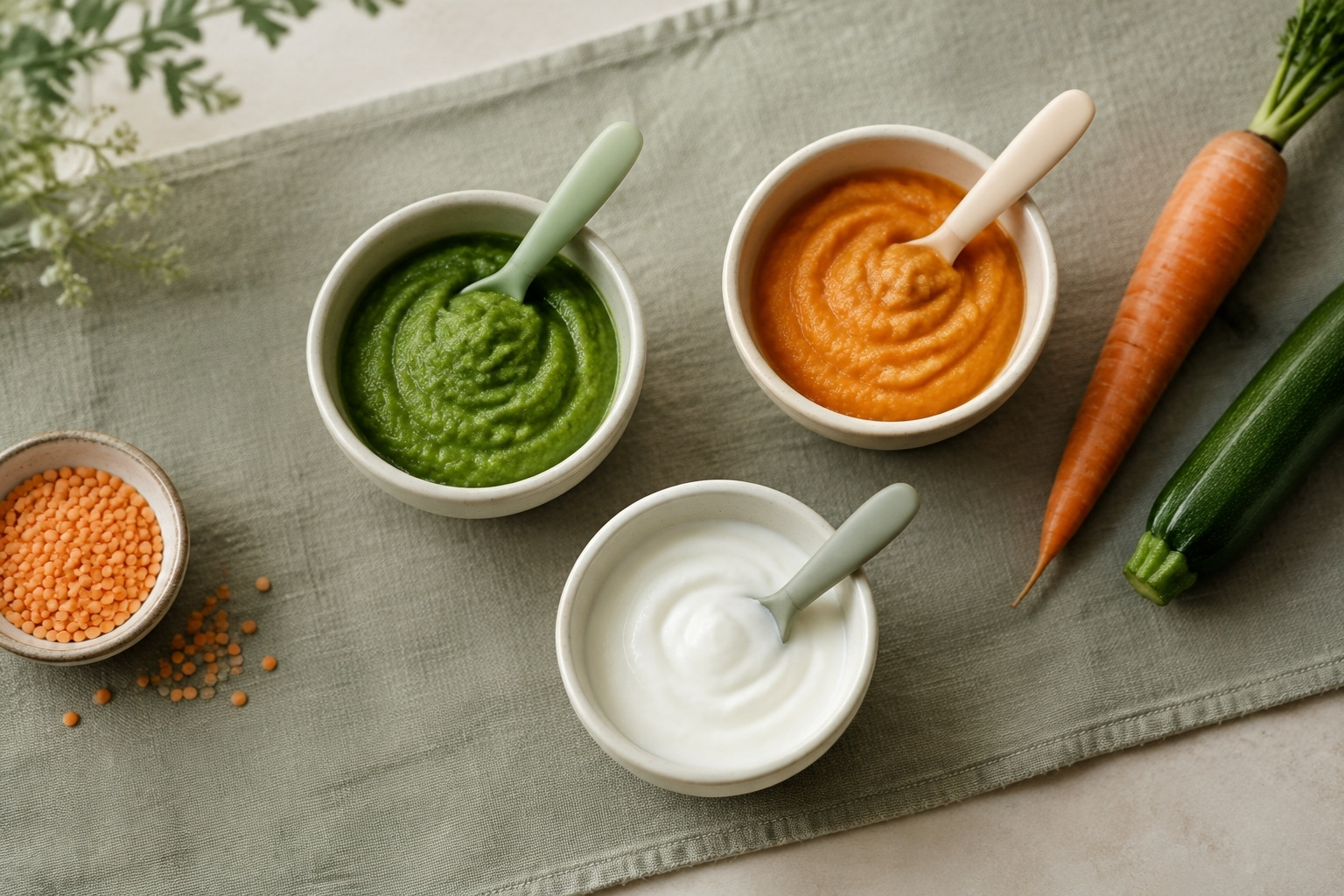
You have seen the readiness signs, the high chair is set up, and now the big question arrives: what goes on the first spoon? The good news is that there is no single "right first food". International bodies do not prescribe a fixed order; what matters is a safe texture, iron-rich options and a calm start that follows your baby's cues.
The short answer
The American Academy of Pediatrics (AAP) says the choice of first foods is up to families, that foods should be soft or puréed, and that foods providing iron and zinc should be included early [1]. The UK National Health Service (NHS) suggests that a small amount of food once a day is enough at first, and that starting with less sweet vegetables such as broccoli, cauliflower and spinach may help babies get used to a range of flavours [2].
A practical plan for day one
- Timing: pick a time when your baby is rested and slightly hungry and you are not in a hurry. Midday lets you observe any reaction during the day.
- Seating: sit your baby upright in a high chair, supported at the sides with a rolled towel if needed.
- Amount: a few teaspoons are enough. The US Centers for Disease Control and Prevention (CDC) suggests starting with 1–2 tablespoons [3].
- Texture: a smooth purée or a soft food mashed very well with a fork. If you prefer finger foods, offer finger-length pieces soft enough to squash between the gums and easy for your baby to hold in a fist.
- Milk: breastfeeding or formula continues as usual; breast milk or infant formula remains the main drink for the first year [2].
Suitable foods for the first week
| Food group | Examples | Preparation tip |
|---|---|---|
| Vegetables | Courgette, carrot, broccoli, cauliflower, pumpkin | Steam until very soft, then mash |
| Iron-rich | Red lentils, well-cooked egg, minced meat, chicken | Mashed, finely shredded or mixed with vegetables |
| Grains | Oats, fine bulgur, rice (vary your grains) | Soft porridge with water, breast milk or formula |
| Dairy | Plain full-fat yoghurt | No added sugar or fruit |
| Fruit | Banana, pear, peach, apple (cooked) | Ripe and soft; cook harder fruit |
The family-information page of Dr. Behçet Uz Children's Hospital, part of Türkiye's Ministry of Health network, suggests plain home-made yoghurt — a long-standing favourite in Turkish homes — as one of the first foods [4]. Yoghurt is a good start, but it is not enough on its own, and iron-rich foods should be added soon.
Why iron matters from week one
Term babies have adequate iron stores in the early months, but needs rise quickly after six months. The US National Institutes of Health Office of Dietary Supplements (NIH ODS) notes that infants not receiving iron-rich foods can become iron deficient between six and nine months [5]. Iron from animal foods (haem iron) is absorbed better than plant iron, and plant iron is absorbed better when eaten with vitamin C-rich foods [5][6]. Adding a little tomato or pepper to a lentil purée, for example, is a good pairing.
How far apart should new foods be?
Sources differ slightly here. The CDC and AAP suggest adding a new single-ingredient food every 3–5 days so that any reaction can be linked to a specific food [7][1]. The NHS emphasises introducing allergenic foods one at a time and in very small amounts, without specifying a fixed number of days per food [8].
Practical tip: when offering a higher-allergy food (egg, peanut, sesame, fish, wheat, dairy) for the first time, add only one new one at a time and watch for a few days. Vegetables and grains your baby has already eaten without problems can be mixed freely. If your baby has eczema or has reacted to a food before, or there is a family history of food allergy, eczema, asthma or hay fever, plan with your doctor [8].
What to expect in the first week
- Grimacing is normal. A first reaction to a new taste is often surprise rather than dislike.
- Much of the food may come back out. Your baby is learning to swallow.
- Gagging is common. Noisy gagging is a normal part of adapting to new textures [9].
- Stools change. After solids begin, stools may become firmer and more variable in colour [1].
What to avoid this week
- Honey (until 12 months) [10]
- Added salt, sugar, grape molasses, syrups and stock cubes [2][12]
- Cow's milk as a drink (until 12 months) [10]
- Fruit juice (not given before 12 months) [10]
- Choking hazards such as whole nuts, whole grapes and hard raw vegetables [11]
When to see a doctor
- hives, lip swelling or repeated vomiting after a new food;
- intense gagging and vomiting with every spoonful for a whole week;
- blood in the stool, persistent watery stools or marked distress;
- uncertainty about how to start because of eczema, a known allergy or preterm birth.
Emergency
If you see breathing difficulty, wheezing, swelling of the tongue or throat, reduced alertness, or silent, ineffective coughing with blue colouring, call your local emergency number at once.
Key takeaways
- There is no single "right first food"; soft textures and safety come first.
- Add iron-rich foods from the first weeks.
- At first, one meal a day and a few spoonfuls are enough; milk feeds continue.
- Introduce allergenic foods one at a time; if there are risk factors, plan with your doctor.
Please note
This article is general information; it does not replace medical advice, diagnosis or treatment for your child. Its statements were checked against the organisations and publications linked below (such as WHO, NHS, CDC, AAP and the Turkish Ministry of Health). Talk to your family doctor or paediatrician about decisions for your child; in an emergency, call your local emergency number.
Last updated: 8 November 2026 · Sources checked: 9 November 2026 · The cover image was generated with AI.
Sources
- [1] American Academy of Pediatrics (HealthyChildren.org). When Can Babies Start Solid Foods? Readiness & Feeding Tips · Accessed: 8 November 2026
- [2] NHS (Best Start in Life). 6 months – Feeding your baby · Accessed: 8 November 2026
- [3] US Centers for Disease Control and Prevention. How Much and How Often To Feed · Accessed: 8 November 2026
- [4] SBÜ İzmir Dr. Behçet Uz Çocuk Hastalıkları ve Cerrahisi EAH (T.C. Sağlık Bakanlığı). Tamamlayıcı Beslenme · Accessed: 8 November 2026
- [5] NIH Office of Dietary Supplements. Iron – Fact Sheet for Health Professionals · Accessed: 8 November 2026
- [6] US Centers for Disease Control and Prevention. Iron · Accessed: 8 November 2026
- [7] US Centers for Disease Control and Prevention. When, What, and How to Introduce Solid Foods · Accessed: 8 November 2026
- [8] NHS (Best Start in Life). Introducing foods that could trigger an allergic reaction · Accessed: 8 November 2026
- [9] NHS (Best Start in Life). Choking and gagging on food · Accessed: 8 November 2026
- [10] US Centers for Disease Control and Prevention. Foods and Drinks to Avoid or Limit · Accessed: 8 November 2026
- [11] US Centers for Disease Control and Prevention. Choking Hazards · Accessed: 8 November 2026
- [12] NHS. Your baby's first solid foods · Accessed: 9 November 2026
More free articles
Starting solids and safety
Starting Solid Foods: The Essentials
When, how and what to watch for as your baby begins solids
5 min read · Free
Starting solids and safety
Why Start Solids at Around Six Months?
The science behind the six-month recommendation and how health bodies differ
5 min read · Free
Starting solids and safety
Is My Baby Ready for Solids? The Real Readiness Signs
Genuine signs, misleading cues and how to observe your baby
5 min read · Free