
Foods and Drinks to Avoid in the First 12 Months
Honey, salt, sugar, cow's milk and the reasons behind each restriction
Lokmi Editorial Team · Last updated: · 5 min read · Relevant age: 6–12 months
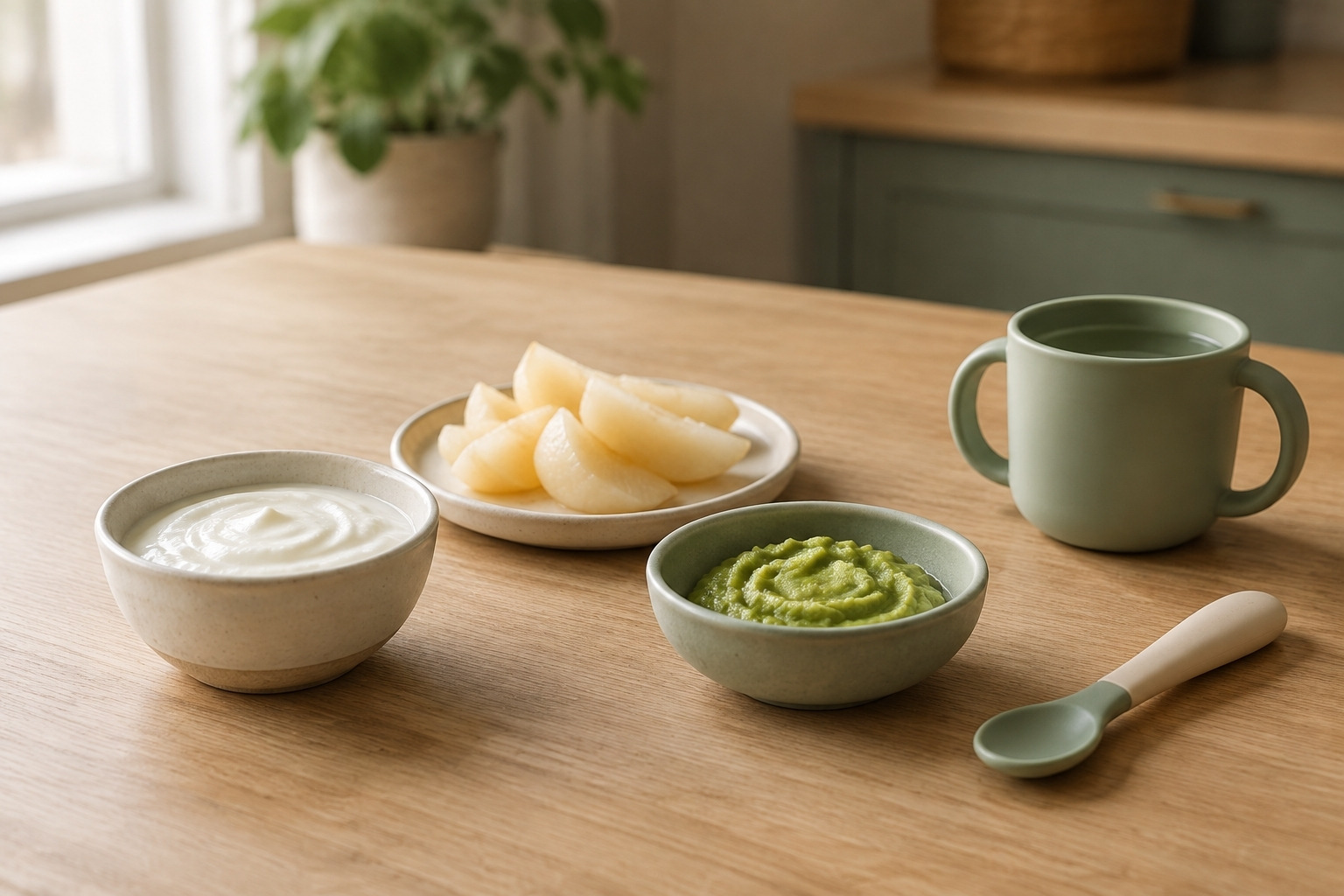
During complementary feeding, the list of what your baby can eat grows every week. But until the first birthday, some foods and drinks should be kept away — because of immature kidneys and immune defences, or because of choking, infection or contaminant risks. This article explains the reasons behind each restriction and what you can offer instead.
The short list
| Avoid | Why? | Until when? |
|---|---|---|
| Honey (even in cooked foods) | Risk of infant botulism [1][2] | 12 months |
| Added salt, salty foods | Not good for the kidneys [1] | First year (and limited after) |
| Added sugar, sugary foods | Tooth decay, preference for sweetness [1][2] | Not recommended before age 2 [2] |
| Cow's milk as a drink | Unsuitable nutrient balance, iron-deficiency risk [1][2][7] | 12 months (small amounts in cooking are fine) |
| Fruit juice | Unnecessary sugar, tooth decay [2][3] | 12 months |
| Sugary, fizzy and caffeinated drinks, tea, coffee | Sugar and caffeine [1][2] | Caffeine and sugary drinks not recommended before age 2 [2] |
| Rice drinks | Arsenic [1][4] | 5 years |
| Unpasteurised milk and cheese | Listeria and other bacteria [1][2] | Throughout childhood |
| Mould-ripened soft cheeses (brie, camembert, roquefort) | Listeria [1] | Early childhood |
| Raw shellfish | Food poisoning [1] | Early childhood |
| Shark, swordfish, marlin | High mercury [1][2] | Early childhood |
| Whole nuts, popcorn, hard sweets | Choking [1] | 5 years |
Honey: why so strict?
Honey can contain spores of Clostridium botulinum, which can multiply in a baby's gut and produce toxin. This can cause infant botulism, an illness that may lead to serious muscle weakness [1][2]. Because cooking does not reliably destroy the spores, honey should not be given in the first year even in cakes, biscuits or desserts [9]. The US Centers for Disease Control and Prevention (CDC) also warns against putting honey on a dummy (pacifier) [2].
Salt and sugar
The UK National Health Service (NHS) says babies should not eat salty foods because they are not good for their kidneys; this includes cured sausages, salami, crisps, crackers, instant soups, stock cubes and takeaways [1]. WHO's 2023 guideline likewise recommends that children aged 6–23 months do not consume foods high in sugar, salt and trans fats [5]. Grape molasses (pekmez), honey and syrups also count as added sugars.
Cow's milk and other milks
Cow's milk does not provide the nutrient balance a baby needs, so it is not given as a drink in the first year, although small amounts can be used in cooking [1][6]. The same applies to goat's and sheep's milk [6]. Plant-based drinks (soya, oat, almond) are not recommended before 12 months, and rice drinks should not be given until age five because of their arsenic content [1][6].
Note: WHO's 2023 guideline conditionally states that non-breastfed infants aged 6–11 months may be given either formula or animal milk [5]. The common recommendation in Türkiye and Europe, however, is no cow's milk as a drink in the first year. If your baby is not breastfed, discuss which milk is appropriate with your doctor.
Fruit juice and other drinks
The American Academy of Pediatrics (AAP) recommends no fruit juice for babies under 12 months; it offers no nutritional benefit at this age and increases the risk of tooth decay [3]. The best drinks in the first year are breast milk, infant formula and, from six months, a few sips of water with meals [6]. Tea (black and green), coffee, cola and energy drinks contain caffeine, and no safe caffeine limit has been established for young children [2]. Most herbal teas and "baby teas" contain sugars and are not recommended [1].
Points specific to Turkish kitchens
- Village cheese and loose milk: milk and cheese whose pasteurisation status is unknown should not be given to babies [1][2]. Choose products labelled as pasteurised.
- Sucuk, pastırma, salami: high in both salt and additives; keep them away in the first year [1].
- Pickles and brined foods: very salty.
- Broad beans (bakla): Dr. Behçet Uz Children's Hospital, part of Türkiye's Ministry of Health network, advises not giving broad beans in the first year [7]. If there is a family history of G6PD deficiency (favism), be sure to discuss this with your doctor [11].
- Eggs: eggs can be given in the first year, but both yolk and white must be well cooked. Although some Turkish sources advise delaying egg white until age one, current international guidelines support introducing well-cooked egg around six months [7][8]. We cover this difference in detail in "Egg Allergy and Introducing Egg Safely".
What to offer instead
- Instead of honey or sugar for sweetness: ripe banana, or cooked apple or pear purée
- Instead of salt: fresh herbs such as thyme, mint and dill; a little cinnamon or cumin
- Instead of fruit juice: whole, soft fruit
- Instead of instant soups: home-made vegetable or lentil soup without salt
When to see a doctor
If your baby has accidentally eaten honey, don't panic. But if over the following days you notice constipation, weak sucking, a weaker cry, drooping eyelids or general floppiness, seek medical care immediately [9][10].
Emergency
If you see breathing difficulty, marked muscle weakness, inability to swallow, reduced alertness or signs of choking, call your local emergency number.
Key takeaways
- No honey in the first year — not even in cooked foods.
- Don't add salt, sugar, grape molasses or syrups; avoid salty and sugary ready-made products.
- Cow's milk as a drink only after 12 months; no rice drinks before age five.
- Fruit juice, tea and caffeinated drinks are not suitable for babies.
- Avoid unpasteurised dairy, raw shellfish and high-mercury fish.
Please note
This article is general information; it does not replace medical advice, diagnosis or treatment for your child. Its statements were checked against the organisations and publications linked below (such as WHO, NHS, CDC, AAP and the Turkish Ministry of Health). Talk to your family doctor or paediatrician about decisions for your child; in an emergency, call your local emergency number.
Last updated: 8 November 2026 · Sources checked: 9 November 2026 · The cover image was generated with AI.
Sources
- [1] NHS (Best Start in Life). Foods and drinks to avoid (Safe weaning) · Accessed: 8 November 2026
- [2] US Centers for Disease Control and Prevention. Foods and Drinks to Avoid or Limit · Accessed: 8 November 2026
- [3] American Academy of Pediatrics (HealthyChildren.org). Where We Stand: Fruit Juice for Children · Accessed: 8 November 2026
- [4] ESPGHAN Committee on Nutrition (Hojsak I et al.). Arsenic in rice: a cause for concern. J Pediatr Gastroenterol Nutr 2015;60:142-145 · Accessed: 8 November 2026
- [5] World Health Organization. WHO Guideline for complementary feeding of infants and young children 6–23 months of age · Accessed: 8 November 2026
- [6] NHS. Drinks and cups for babies and young children · Accessed: 8 November 2026
- [7] SBÜ İzmir Dr. Behçet Uz Çocuk Hastalıkları ve Cerrahisi EAH (T.C. Sağlık Bakanlığı). Tamamlayıcı Beslenme · Accessed: 8 November 2026
- [8] NHS (Best Start in Life). Introducing foods that could trigger an allergic reaction · Accessed: 8 November 2026
- [9] World Health Organization. Botulism (fact sheet) · Accessed: 9 November 2026
- [10] US Centers for Disease Control and Prevention. Botulism Signs and Symptoms · Accessed: 9 November 2026
- [11] US National Library of Medicine (NIH) – MedlinePlus Genetics. Glucose-6-phosphate dehydrogenase deficiency · Accessed: 9 November 2026
More free articles
Starting solids and safety
Starting Solid Foods: The Essentials
When, how and what to watch for as your baby begins solids
5 min read · Free
Starting solids and safety
Why Start Solids at Around Six Months?
The science behind the six-month recommendation and how health bodies differ
5 min read · Free
Starting solids and safety
Is My Baby Ready for Solids? The Real Readiness Signs
Genuine signs, misleading cues and how to observe your baby
5 min read · Free