
Gagging vs Choking: How to Tell the Difference
Noisy gagging is normal, silent choking is an emergency: learn the difference
Lokmi Editorial Team · Last updated: · 5 min read · Relevant age: 6–59 months
Almost every parent who starts solids experiences those few seconds when their baby's face goes red and they gag. Frightening as it looks, this is usually a completely normal reflex that protects your baby. Severe choking, by contrast, is usually silent and needs fast action. Telling the two apart prevents unnecessary panic and buys precious seconds in a real emergency.
The short answer
The UK National Health Service (NHS) sums it up: gagging is loud; severe choking is usually quiet [1]. Gagging is a normal reflex as a baby learns how much food they can chew and swallow at once. In choking, the airway is blocked. If the blockage is partial, the baby may cough loudly; encourage them to keep coughing and stay with them. If the cough becomes silent or ineffective, or the baby cannot make sound or breathe in properly, this is severe choking and needs emergency action [2].
Why do babies gag?
Gagging happens because babies are learning to regulate how much food they can chew and swallow at one time. Over time they learn to cope with different textures and harder foods [1].
A gagging baby may [1]:
- make loud gagging or retching noises;
- have watery eyes;
- push the tongue forward, with food coming out of the mouth;
- go red in the face (harder to see on darker skin);
- sometimes vomit.
What happens in choking?
In choking, food or an object partly or completely blocks the airway. With a partial blockage the baby may cough loudly [2]. Signs of severe choking described by the NHS include [1][2]:
- silence: the baby cannot cry or make sound;
- coughing that is absent, silent or ineffective;
- inability to breathe or struggling to breathe;
- blue skin in babies with lighter skin; blue inner lips, gums or nail beds in babies with darker skin.
Side-by-side comparison
| Gagging | Severe choking | |
|---|---|---|
| Sound | Noisy | Silent or ineffective cough |
| Colour | Face may go red | Turning blue (lips, gums, nails) |
| Breathing | Continues | Cannot breathe or struggles hard |
| What to do | Stay calm, let your baby clear it | Immediate first aid and emergency call |
What to do when your baby gags
- Stay calm. Your panic can frighten your baby and make future meals harder.
- Keep your baby upright and let them cough.
- Don't sweep blindly with your finger. The NHS warns that poking without seeing the object can push it further in [2].
- Don't slap the back at random; a baby who is coughing effectively does not need intervention.
- Once the gag passes, your baby can carry on eating if they want to.
What to do in choking
According to NHS first-aid guidance [2]:
- If your baby is coughing effectively, encourage them to keep coughing and stay with them.
- If the cough is silent or ineffective, shout for help and call your local emergency number, using speakerphone.
- Baby under 1 year, still conscious: sit down and lay your baby face down along your forearm or thigh, supporting the head and neck with your hand; give up to 5 sharp back blows between the shoulder blades with the heel of your hand. If the object does not come out, lay your baby face up along your thighs, feet towards you and head lower than the feet, and give up to 5 chest thrusts with two fingers in the middle of the chest, just below the nipple line. Check after each blow or thrust whether the object has come out.
- Child over 1 year: back blows are followed by abdominal thrusts. If the object does not come out and the child is still conscious, keep repeating back blows and chest thrusts (under 1) or abdominal thrusts (over 1) until help arrives [2].
- If the child becomes unconscious: place them on a firm surface and begin basic life support until help arrives.
- Even if the object comes out, have your child checked by a health professional; part of it may remain, or the procedure may have caused injury [2].
These steps are best learned hands-on rather than from text. We recommend a baby and child first-aid course before starting solids.
How to reduce choking risk
- Always seat your baby upright and stay with them throughout the meal [3].
- Don't feed while your baby is crying, laughing, walking around or travelling in a car [3].
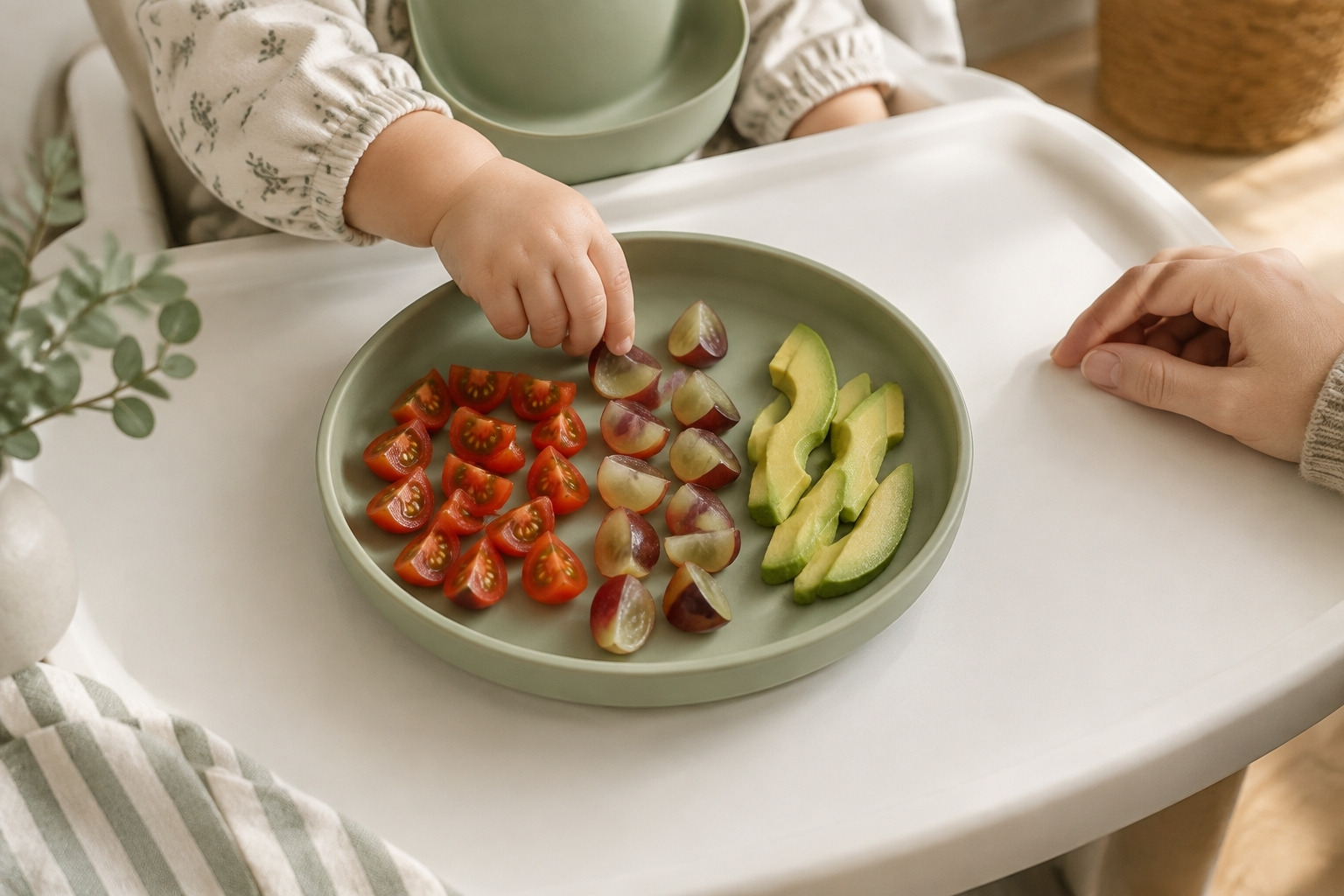
- Transform round, hard foods: quarter grapes and cherry tomatoes lengthways and cook hard vegetables until soft.
- Whole nuts, popcorn, hard sweets, sausages and large chunks of meat or cheese are choking hazards in the early years [3].
- Don't give nut butter by the spoonful; spread it thinly or mix it into food [3].
When gagging might be a problem
Gagging is very common in the first weeks and decreases as babies get used to textures. But talk to your doctor if you notice:
- persistent gagging and vomiting at every meal despite months of practice;
- marked fear or crying around food;
- weight loss or poor weight gain;
- acceptance of only very smooth textures with no progress by 9–10 months.
For these situations, see Lokmi's article "When Should a Baby Who Gags Constantly Get Support?".
Key takeaways
- Gagging is noisy and normal; severe choking is usually silent and an emergency. With a partial blockage, encourage a coughing child to keep coughing and stay with them.
- Don't intervene when your baby is gagging; stay calm and keep them upright.
- In choking, shout for help, call your emergency number and give age-appropriate first aid.
- Safe food shapes, upright seating and constant supervision reduce choking risk.
Please note
This article is general information; it does not replace medical advice, diagnosis or treatment for your child. Its statements were checked against the organisations and publications linked below (such as WHO, NHS, CDC, AAP and the Turkish Ministry of Health). Talk to your family doctor or paediatrician about decisions for your child; in an emergency, call your local emergency number.
Last updated: 8 November 2026 · Sources checked: 9 November 2026 · The cover image was generated with AI.
Sources
- [1] NHS (Best Start in Life). Choking and gagging on food · Accessed: 8 November 2026
- [2] NHS. How to stop a child from choking · Accessed: 8 November 2026
- [3] US Centers for Disease Control and Prevention. Choking Hazards · Accessed: 8 November 2026
More free articles

Starting solids and safety
Starting Solid Foods: The Essentials
When, how and what to watch for as your baby begins solids
5 min read · Free

Starting solids and safety
Why Start Solids at Around Six Months?
The science behind the six-month recommendation and how health bodies differ
5 min read · Free

Starting solids and safety
Is My Baby Ready for Solids? The Real Readiness Signs
Genuine signs, misleading cues and how to observe your baby
5 min read · Free