
Preparing Food Safely to Reduce Choking Risk
Size, shape and texture: practical rules for your kitchen
Lokmi Editorial Team · Last updated: · 4 min read · Relevant age: 6–59 months
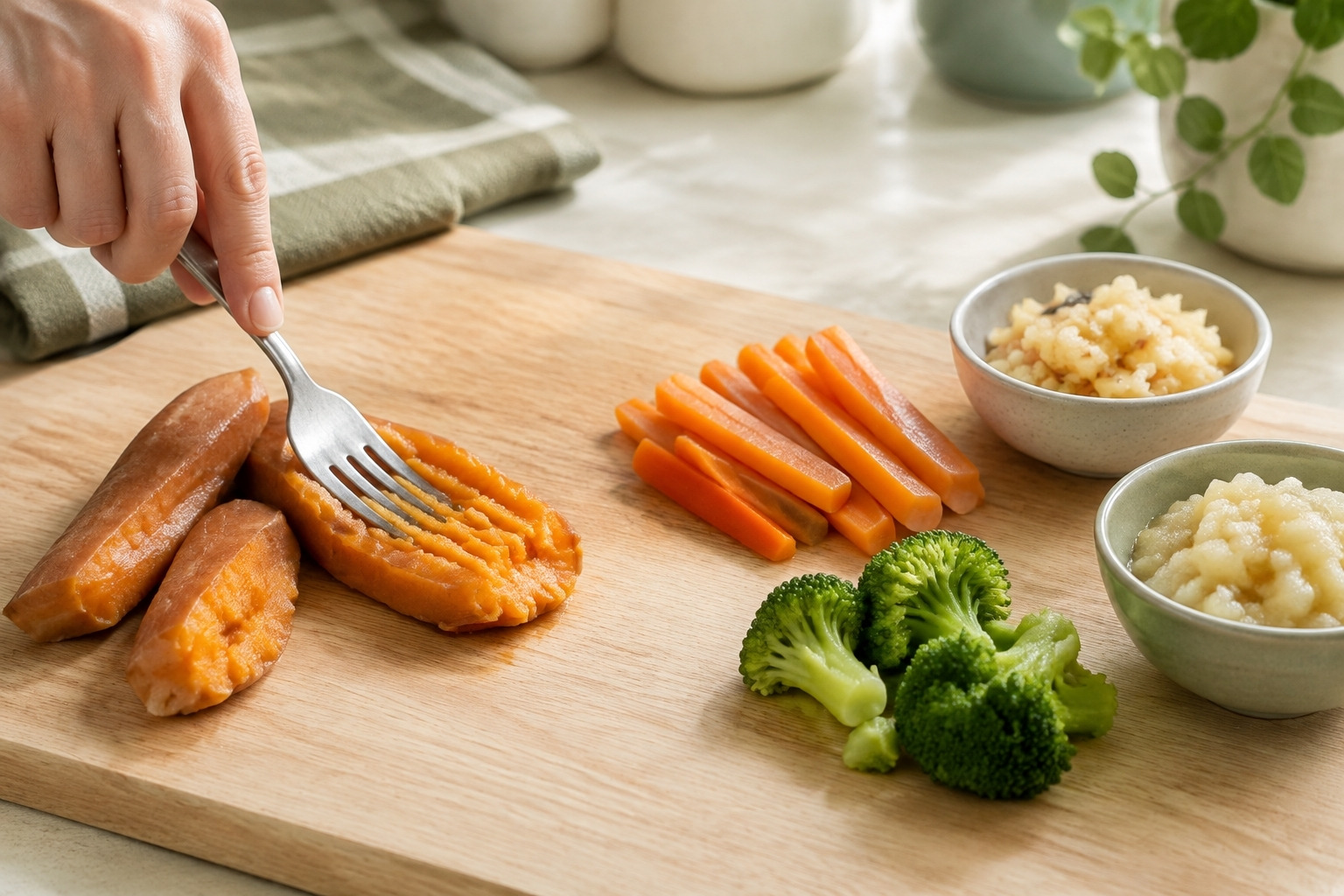
Whether a food is safe for a baby often depends less on the food itself than on how it is prepared. The same apple is a choking hazard when raw and diced, yet can easily be offered to a seven-month-old once steamed soft and thinly sliced or grated. This guide brings together practical preparation rules you can use in your own kitchen.
Three key criteria: size, shape and texture
The UK National Health Service (NHS) advises thinking about three things when preparing food for babies and young children: size, shape and texture [1]. Firm foods, bones and small round foods are riskier. The general rule is to cut food into narrow batons (finger-length strips) and avoid round shapes and firm textures [1].
Practical tip — the squash test: press a soft piece of food gently between your thumb and forefinger. If it squashes easily, a baby without teeth can mash it with their gums. If not, cook it a little longer or prepare it differently.
Food-by-food preparation table
| Food | Risky form | Safer form |
|---|---|---|
| Grapes, cherries, blueberries, strawberries, cherry tomatoes | Whole | Quartered (mashed for very young babies) [1] |
| Apple, pear (firm) | Raw cubes or whole slices | Steamed soft thin slices, or grated [1] |
| Carrot, pepper, cucumber, celery | Raw rounds or cubes | Cooked and mashed for young babies; narrow batons for older ones [1] |
| Melon, watermelon | Small balls or cubes | Thin slices with seeds removed [1] |
| Chickpeas, haricot and borlotti beans | Whole | Mashed or flattened [1][2] |
| Sausages, sucuk, salami | Round slices | Best avoided; if given, peeled and cut lengthways into thin strips [1] |
| Meat, chicken | Large, tough pieces | Well cooked, shredded or very thin strips, bones removed [1] |
| Fish | With bones | All bones removed, flaked [1] |
| Cheese | Large cubes | Grated or short, narrow strips [1] |
| Nuts and seeds | Whole or coarsely chopped | Finely ground, or as a smooth paste mixed into food [1][2] |
| Peanut butter, tahini | By the spoonful | Spread thinly or mixed into yoghurt, porridge and similar [1][2] |
| Raisins, dried apricots | Whole (under 1 year) | Cut into small pieces, ideally mixed into food [1] |
| White bread | Soft dough balls | Lightly toasted, in narrow strips; or wholemeal bread [1] |
| Popcorn, hard sweets, chewing gum, marshmallows | Any form | Not given under 5 years [1][3] |
Notes from the Turkish kitchen
- Roasted chickpeas (leblebi), hazelnuts, walnuts, sunflower seeds: never given whole before age five [1]. Hazelnuts and walnuts can be ground to a fine powder and stirred into yoghurt or porridge.
- Pomegranate seeds: small, hard and slippery, so they need care in the early years; whole pomegranate seeds should not be given to babies.
- Köfte and mince dishes: make them soft and easily crumbled; long, soft köfte shapes a baby can hold in a fist are more suitable than round balls.
- Corn kernels: whole kernels are a choking hazard [2]; offer corn mashed or puréed.
- Simit: its sesame crust is hard and unsuitable for young babies; to introduce sesame, stir tahini into food instead.
General approach by age
- 6–8 months: smooth purées, mashed foods, and soft finger-length pieces that squash easily against the gums.
- 9–11 months: chopped, lumpy textures; small, soft bites; babies begin using a pincer grasp to pick up small pieces.
- 12 months onwards: family foods cut appropriately. Even so, high-risk foods such as whole nuts, popcorn and hard sweets should be avoided until age five [1].
The meal setting is part of preparation
- Your baby should be alert, calm and sitting upright in a high chair [1].
- An adult should be beside them for the whole meal [1][2].
- Never feed in a car seat or pushchair, or while walking or running [2].
- Don't rush; adults can model slow chewing and swallowing [1].
Grain products and snacks that are easy to overlook
When people think of choking risks they usually think of grapes and nuts, but the list shared by the CDC also includes some grain products and snacks [2]:
- Whole grain kernels such as wheat or barley, even when cooked. In Turkish cooking this includes the whole wheat used for aşure and cracked wheat (yarma); mash dishes made with these grains well before giving them to a baby.
- Crackers and breads with seeds, nut pieces or whole grain kernels.
- Dry snacks such as crisps, pretzels and popcorn, as well as cookies and granola bars.
- Whole pieces of canned fruit, chewy fruit snacks and gummy sweets.
The CDC also advises keeping mealtimes calm, without rushing and without distractions [2].
When to see a doctor
- your baby coughs or gags constantly even with soft, age-appropriate textures;
- you notice a change in voice, wheezy breathing during meals or frequent chest infections (possible signs of swallowing difficulty);
- your child has had a choking episode — even if the object came out, they need to be checked.
Emergency
If your baby cannot make a sound, cannot cough effectively or is turning blue, shout for help and call your local emergency number immediately. We recommend a baby and child first-aid course.
Key takeaways
- Risk depends more on preparation than on the food itself: size, shape and texture.
- Quarter round foods, soften firm foods by cooking, and remove bones.
- Whole nuts and popcorn are not given before age five; offer nuts ground or as a paste.
- Upright seating and constant supervision complete even the best preparation.
Please note
This article is general information; it does not replace medical advice, diagnosis or treatment for your child. Its statements were checked against the organisations and publications linked below (such as WHO, NHS, CDC, AAP and the Turkish Ministry of Health). Talk to your family doctor or paediatrician about decisions for your child; in an emergency, call your local emergency number.
Last updated: 8 November 2026 · Sources checked: 9 November 2026 · The cover image was generated with AI.
Sources
- [1] NHS (Best Start in Life). Preparing food safely · Accessed: 8 November 2026
- [2] US Centers for Disease Control and Prevention. Choking Hazards · Accessed: 8 November 2026
- [3] NHS (Best Start in Life). Foods and drinks to avoid (Safe weaning) · Accessed: 8 November 2026
More free articles
Starting solids and safety
Starting Solid Foods: The Essentials
When, how and what to watch for as your baby begins solids
5 min read · Free
Starting solids and safety
Why Start Solids at Around Six Months?
The science behind the six-month recommendation and how health bodies differ
5 min read · Free
Starting solids and safety
Is My Baby Ready for Solids? The Real Readiness Signs
Genuine signs, misleading cues and how to observe your baby
5 min read · Free